Two islands. Four grandparents. Fourteen parishes. One harbour.
Jerk Harbour began long before there was a restaurant, a menu or a name. It began in Montego Bay and in London, continued in St Vincent and across all 14 parishes of Jamaica, and found its home in East Legon, Accra.
Scroll to read the story
Two islands. Four grandparents. Fourteen parishes. One harbour.
Jerk Harbour began long before there was a restaurant, a menu or a name.
It began in Montego Bay, where Bridgette Abtar spent her earliest years surrounded by the warmth of the St James community, the sweetness of June plum and star apple, and childhood visits to the local ice-cream parlour.
It began in London, where Michael Abtar was born to a Jamaican father with roots in Manchester parish and a Vincentian-British mother.
It continued in St Vincent and the Grenadines, where Michael lived for part of his childhood with his grandparents and learned that Caribbean food is never only about feeding people. It is memory, medicine, celebration, discipline and love — served on a plate.
And it continued in the kitchens of his Jamaican and Vincentian grandmothers, and beside his Rastafarian father, who taught him to mix traditional roots tonics and Caribbean elixirs from plants, herbs, spices and inherited knowledge.
Jerk Harbour is where those journeys meet.
The recipe was never written down
In many Caribbean families, recipes do not begin with measurements. They begin with instruction: watch, smell, taste, wait.
Learn how the seasoning should feel between your fingers. Learn what the fire sounds like when it is too fierce. Learn when the smoke is flavouring the food and when it is simply burning it. Learn that some dishes need patience more than they need interference.
That is how much of the knowledge behind Jerk Harbour was first passed on. Not from a printed recipe card, but from standing close enough to someone older to understand what they were doing — and why.
That tradition of oral transmission reflects a much wider Caribbean history in which food knowledge, medicinal preparations, music, language and ritual were preserved across generations despite displacement and colonial violence. UNESCO recognises Jamaica's Maroon communities as custodians of living traditions with deep West and Central African roots, including oral knowledge, medicinal preparations, drumming and the Kromanti cultural tradition.
Jerk Harbour does not claim ownership of that heritage. We approach it with gratitude, humility and respect.


Before Jerk Harbour, there was a journey through Jamaica
Bridgette and Michael did not want to build a restaurant around a narrow or second-hand idea of Jamaican cuisine. Together, they travelled through all 14 parishes of Jamaica, tasting, listening and learning.
They experienced how flavour changes from parish to parish. Coastal communities speak through fish, pepper and acidity. Rural kitchens reveal the power of slow cooking, ground provisions and careful preservation. Markets tell stories through fruit, herbs, spices and the ingredients people carry home.
They travelled not simply to collect dishes, but to understand context. Why is this cooked here? Why is that ingredient used? Who taught you? What has changed? What must never change?
Their journey brought them to Boston Bay in Portland, widely credited as the birthplace of commercially sold jerk in Jamaica and still closely associated with traditional jerk pits and roast breadfruit. They also spent time learning from Maroon chiefs, cultural custodians and historians — encounters that deepened their respect for jerk not merely as a flavour profile, but as food connected to survival, resistance, landscape and autonomy.
From Boston Bay to East Legon.
Jerk is more than heat
Jerk is sometimes reduced to "spicy chicken". That misses almost everything important. At its heart, jerk is a method, a seasoning tradition and a cultural inheritance.
Its character comes from the relationship between pimento, thyme, scallion, Scotch bonnet, aromatics, smoke, controlled heat and time.
The balance matters. Scotch bonnet should bring fruit and fragrance as well as heat. Pimento should add warmth and complexity. Smoke should deepen flavour, not bury it. The marinade should enter the meat rather than merely coat the surface. And the fire must be understood.
The Blue and John Crow Mountains gave Jamaica's Maroon communities refuge, natural resources and a landscape in which they preserved culture while resisting re-enslavement. UNESCO describes the region as central to the history, survival and continuing freedom of the Windward Maroons.
That history deserves more than casual branding. It deserves acknowledgement. Jerk was not invented for a marketing campaign. It emerged from people, place, resistance, ingenuity and survival.

The wider story of Jamaican food
Jamaican cuisine is not one influence. It is a meeting of histories.
The island's first people, the Taíno, contributed ingredients and techniques rooted in the land. Africans carried culinary knowledge, seeds, preservation methods, stewing traditions and ways of making abundance from limited resources. Europeans brought colonial systems and ingredients, often through violence and coercion. Later arrivals from India, China, the Middle East and Europe added further layers to the island's food culture. Jamaica's own tourism authority describes its cuisine as a melding of cultural influences shaped across this history.
From this came a cuisine of extraordinary range: jerk and roast meats; pepper pot and rundown; curry goat; rice and peas; escovitch fish; brown stew; patties; fried dumplings and festival; callaloo; ground provisions; sorrel; punches, roots and tonics; puddings, drops and grater cake.
Jamaican food is inventive without being careless, bold without being one-dimensional and deeply historical without being trapped in the past. At Jerk Harbour, we honour that breadth.

Jamaica and Ghana: a return, not merely a relocation
Bridgette and Michael first visited Ghana in 2017, when Michael was invited by a government agency to speak at a conference. They expected a professional trip. They found something more.
The warmth of the people, the confidence of the culture, the sense of history and the ease of human connection stayed with them. Ghana felt both new and strangely familiar.
In 2020, they moved to Ghana with their two children. They later became Ghanaian citizens following a recommendation from the Office of the President.
Their move was not an attempt to transplant Jamaica unchanged onto Ghanaian soil. It was an opportunity to build respectfully within a country they had come to love.

Across the Atlantic, culture survived
The relationship between Jamaica and Ghana is not simply symbolic. During the transatlantic trafficking and enslavement of Africans, people from the Gold Coast and wider West Africa were forcibly carried to Jamaica. Their descendants preserved and transformed elements of language, spirituality, music, naming, social organisation, food and resistance.
Jamaican cultural institutions continue to recognise strong Ghanaian and particularly Akan influences within Maroon and other traditions. Jamaica's Ministry of Culture has specifically highlighted links between Ghana's Akan heritage and Jamaican language, naming practices, spiritual traditions and Maroon culture. Historical figures such as Tacky, an Akan or Coromantee leader of the major 1760 uprising in Jamaica, also illustrate the presence and influence of Gold Coast peoples in the island's resistance history.
These connections should not be simplified into a claim that every Jamaican custom came directly from one Ghanaian people or one ancient culture. Jamaica was shaped by diverse African societies and by centuries of adaptation in the Caribbean.
But the echoes are real. They can be heard in drums. Seen in naming traditions. Felt in communal life. Recognised in spiritual practice. And tasted in the shared instincts of two cuisines that understand pepper, smoke, starch, slow cooking, leafy vegetables, fermented flavour and food served generously.
“The Atlantic separated people. It did not erase memory.”
Why Jerk Harbour belongs in Accra
Jerk Harbour was created because Bridgette and Michael believed that Ghana deserved a Jamaican restaurant that treated the cuisine with seriousness. Not as a novelty. Not as decoration. Not as "anything spicy" placed beside a Jamaican flag. But as food with lineage, technique, regional variation and soul.
Accra is one of Africa's most dynamic cities. East Legon brings together Ghanaians, returnees, travellers, families, professionals, students and people curious about the world. That makes it the right home for Jerk Harbour.
Here, Jamaica and Ghana do not meet as strangers. They meet as cultures with shared histories, related rhythms and an immediate understanding that food can hold identity.
One Love. One Bite.
Our phrase is simple. But it carries a standard.
One Love means hospitality without pretence. It means treating customers, staff, suppliers and community with dignity. It means remembering that restaurants are built by people, not merely menus.
One Bite means that the standard must be evident immediately. The marinade, the smoke, the texture, the balance and the care must all arrive on the plate together.
It means no imitation smoke, no careless shortcuts, no treating heritage as a costume, and no forgetting that someone has trusted us with their meal.
“Every plate is a small act of heritage.”
Two founders. One shared purpose.
Bridgette brings the instinct for communication, education, feeling and customer experience. Michael brings the kitchen, the fire, the recipes and operational discipline.
Together, they are building more than a restaurant. They are building a meeting place between Jamaica and Ghana; memory and imagination; heritage and enterprise; family knowledge and professional standards; food as comfort and food as culture.
Jerk Harbour is their love letter to the Caribbean. And their thank-you to Ghana.
The story is still being written
The future of Jerk Harbour is not simply about opening more locations. It is about growing without losing what made the food meaningful.
That means protecting authenticity; developing the team; sharing Jamaican food history responsibly; creating memorable private dining and catering experiences; building stronger connections between Caribbean and African culture; giving customers food they want to return to; and ensuring each new chapter still tastes like the first promise.
“The fire may grow. The standard must remain.”
No shortcuts. No imitation heat.
Marinated for a full day
Seasoning goes on the meat and stays there overnight, so flavour sits inside the chicken rather than on it.
24 hours, every batch.
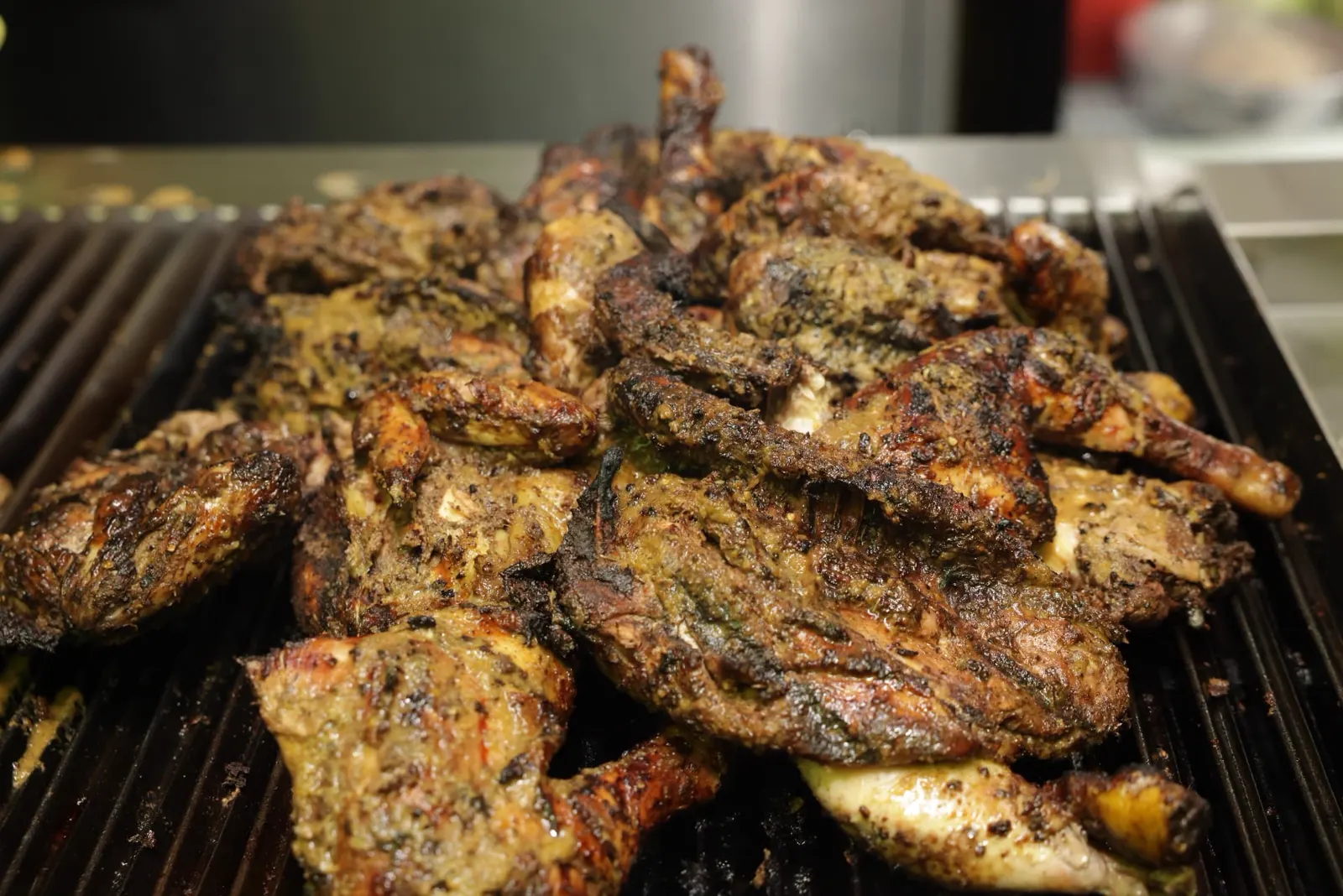
Cooked over live charcoal
Charcoal is lit early and left to settle before anything touches the grate. Smoke is an ingredient, not an effect.
Smoke is built slowly, over settled coals.
Slow where it matters
Oxtail braises for six hours. Curry goat takes as long as it takes. Nothing leaves the pot early to save time.
Oxtail: six hours.
Served with warmth
Portions are generous, the welcome is the same for everyone, and food is built to be shared at the table.
One Love. One Bite.
From fire to plate.
Step 1Season
Fresh thyme, scallion, pimento, ginger and scotch bonnet, prepared the same day.
Step 2Marinate
A full day on the meat. Time is the ingredient nobody can fake.
Step 3Build the fire
Charcoal lit early and left to settle to grey. No gas, no liquid smoke.
Step 4Grill or slow-cook
Jerk over live coals; oxtail and goat in the pot for hours.
Step 5Rest
Meat comes off the fire and waits before it is cut, so the juice stays in it.
Step 6Plate and serve
Rice and peas, festival, slaw, plantain — built to share.
The flavours behind the fire.
How the fire travelled.
- Montego Bay
Bridgette's earliest years in St James
Ripe June plum, cold star apple, ice cream on a warm day, and a community where a child could feel known.
- London
Michael is born to a Jamaican father and a Vincentian-British mother
Roots in Manchester parish, raised between islands, homes and generations.
- St Vincent and the Grenadines
Childhood beside his grandparents
Where Caribbean food revealed itself as memory, medicine, celebration, discipline and love.
- All 14 parishes
A journey through Jamaica
Tasting, listening and learning — from coastal pepper and acidity to slow-cooked ground provisions, and on to the jerk pits of Boston Bay.
- 2017
First visit to Ghana
A professional trip that became something more. Ghana felt both new and strangely familiar.
- 2020
The move to Accra
Bridgette and Michael relocate with their two children, later becoming Ghanaian citizens following a recommendation from the Office of the President.
- Today
Jerk Harbour, East Legon
Live-charcoal Jamaican cooking at the Jungle Avenue Food Court, A&C Mall — where Jamaica and Ghana meet as cultures, not strangers.
Two founders. One shared purpose.
Bridgette Abtar
Executive Director of Brand & Customer Experience
“The food may bring people through the door, but the feeling is what brings them back.”
Born in Montego Bay, St James, Bridgette carries vivid memories of a place where friendliness felt natural, neighbours felt close and food was woven into everyday happiness. With a background in marketing, communications and education, she ensures every touchpoint — from the first social post to the moment a meal reaches the table — feels warm, thoughtful, clear and unmistakably Jerk Harbour.
Michael Abtar
Executive Chef & Managing Director
“Tradition gives us the foundation. Discipline ensures that we do it justice.”
Born in London to a Jamaican father and a Vincentian-British mother, Michael learned to cook from his grandmothers — tasting as you go, respecting ingredients, letting time do its work — and learned roots, tonics and elixirs from his Rastafarian father. Trained as a lawyer and founder of the multi-award-winning consultancy IG-Smart Ltd, he brings the same rigour to the grill.
Jamaican in spirit, at home in East Legon.
You'll find us in the Jungle Avenue Food Court at A&C Mall. We cook for office lunches around East Legon and Airport, cater celebrations across Greater Accra, and serve a room that is equally Ghanaian and international. Two food cultures that already agree on pepper, smoke and patience.
“Do yourself a favor and go get some delectable Jerk Harbour curry goat as soon as you can! We also love the generous servings of jerk chicken, the rice and peas (Jamaican Waakye) and the oxtail. Delicious + friendly service. The location in a food court with a bar at one end also offers a nice chance to enjoy beers with your meal. Updating my review after 10 months to say food quality is still on point and service staff are even more attentive than when they first opened. Great to have this reliable option to take family and friends to enjoy flavors of the Caribbean in Ghana!”
Tiffany Talsma · Google — Local Guide
Rated 5.0 from 13 guest reviews. Read the reviews
Taste what the journey became.
From Montego Bay to Manchester parish. From St Vincent to London. From all 14 parishes of Jamaica to East Legon. From grandparents' kitchens to the charcoal grill. From inherited memory to a new Ghanaian home. This is Jerk Harbour.
One Love. One Bite.